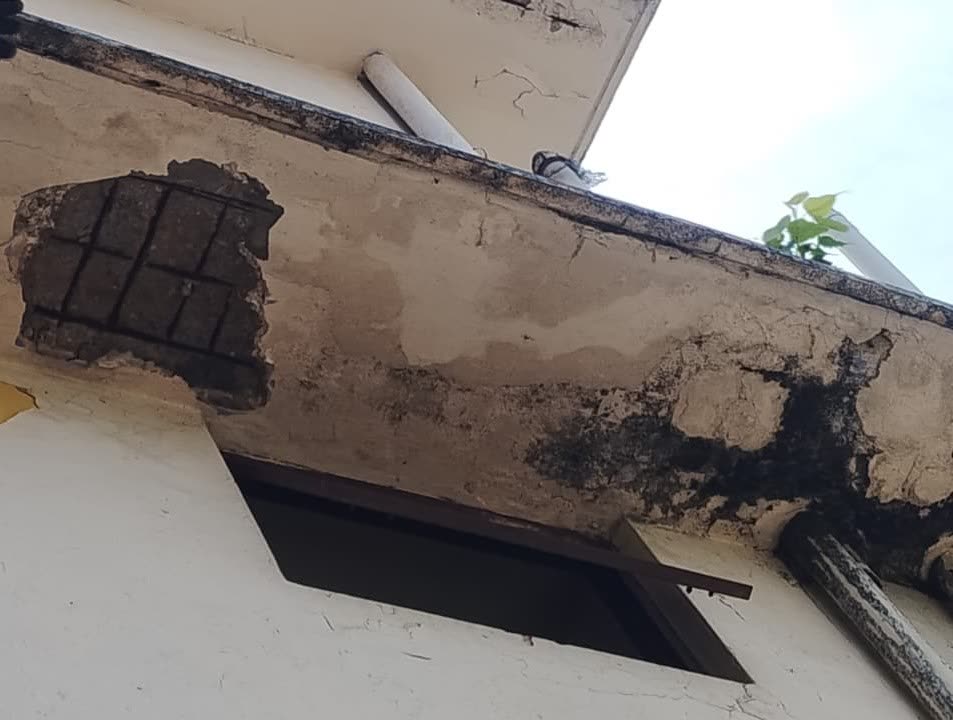
“We used M20, like everyone else” is something we hear often when we audit older buildings — usually while looking at rusted bars falling out of a sunshade. The grade of concrete is not only about strength. It decides how well the steel inside is protected for the life of the building.
What the grade means
M stands for mix and the number is the characteristic compressive strength in N/mm², measured on 150 mm cubes after 28 days[1]. M25 concrete should reach at least 25 N/mm². Higher grades are stronger, but just as importantly they are denser, so water, air and salts take far longer to reach the steel.
IS 456 sets the minimum by exposure
IS 456:2000 does not let the designer choose the grade on strength alone. It first asks how harsh the environment is, then sets a minimum grade and a minimum cover of concrete over the steel for reinforced concrete[1],[2]:
- Mild — protected from weather, such as interiors: M20, 20 mm cover
- Moderate — sheltered from severe rain, exposed to condensation and ordinary rain, or buried in non-aggressive soil: M25, 30 mm cover
- Severe — exposed to severe rain, alternate wetting and drying, or a coastal environment: M30, 45 mm cover
- Very severe — exposed to sea water spray or aggressive soil: M35, 50 mm cover
- Extreme — tidal zones and members in direct contact with aggressive chemicals: M40, 75 mm cover
The code also caps the water–cement ratio and sets a minimum cement content for each exposure — for moderate exposure, a maximum water–cement ratio of 0.50 and at least 300 kg of cement per cubic metre[1].
What this means in practice
Your structural engineer decides the exposure of each member, and in most climates the answer is rarely mild. Members inside the building and sheltered from the weather are moderate at worst — M25. External beams, sunshades and slabs that take heavy rain, and almost everything near the coast where sea air carries salt inland, fall under severe exposure — M30 with 45 mm cover. Footings and columns also have their own minimum covers under the code. M20 is rarely the right answer for exposed RCC.
Cover is where buildings fail
Even good concrete cannot protect steel that sits too close to the surface. Cover blocks that are missing, crushed or too small are one of the most common causes of early corrosion we find. Ask your contractor to use proper cover blocks of the size shown on the drawings, tied firmly to the cage, and check them before every pour.
Quick site checklist
- The grade and cover on the drawings match the exposure of your site
- Ready-mix delivery tickets show the specified grade
- Cubes are cast from each pour and tested at 7 and 28 days
- No extra water is added on site to make concrete easier to place
- Concrete is kept moist (cured) for at least the period the code requires
Choosing M25 instead of M20 adds little to the cost of a house. Repairing corroded concrete twenty years later costs many times more.
Sources
- [1]IS 456:2000 — Plain and Reinforced Concrete, Code of Practice (Bureau of Indian Standards)
- [2]The Constructor — Environmental exposure conditions of structures (IS 456)
Indian Standards are published by the Bureau of Indian Standards; links point to public copies. Always design to the current edition.
This article is general information, not engineering advice for your building. Always have a qualified structural engineer check your structure. Read our disclaimer.
Learn this hands-on, or let us do it for you.