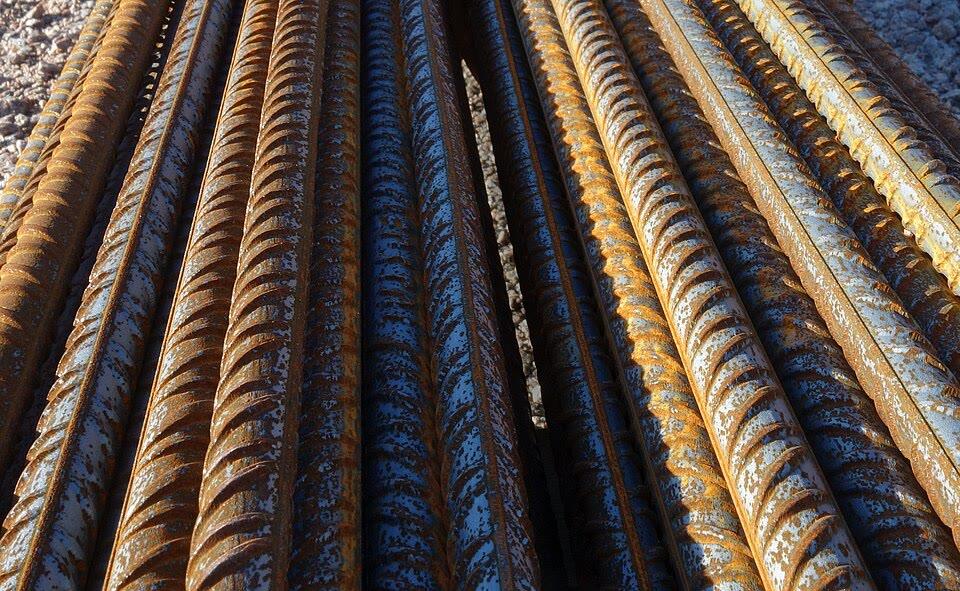
Steel is one of the biggest costs in a house, and the bars are hidden inside the concrete for the life of the building. Yet most owners choose them on brand and price alone. Here is what the grade on the bar actually means.
What the numbers mean
Reinforcement bars in India are made to IS 1786[1]. The number in the grade is the minimum yield strength in N/mm²: Fe 500 bars must not start to yield below 500 N/mm², Fe 550 below 550 N/mm². Your structural engineer designs every beam, column and slab assuming a particular grade, so the grade on site must match the grade on the drawings.
What the “D” adds
The D stands for higher ductility — the ability of the bar to stretch a long way before it breaks. Fe 500 and Fe 500D have the same minimum yield strength, but IS 1786 asks more of the D grade:
- Higher minimum elongation — 16% for Fe 500D against 12% for Fe 500[1],[3]
- A higher minimum tensile strength — 565 N/mm² against 545 N/mm²[1],[3]
- A minimum margin between tensile and yield strength, so the bar keeps carrying load after it yields
- Tighter limits on carbon, sulphur and phosphorus, which improves ductility and weldability
Why ductility matters in an earthquake
Much of India lies in Seismic Zone III or higher. In a strong earthquake, a well-designed building is expected to bend and crack in a controlled way rather than snap. That controlled bending happens in the steel. A ductile bar stretches and absorbs energy; a brittle one can fracture suddenly. That is why IS 13920, the code for ductile detailing of RCC buildings in earthquake zones, asks for high-ductility reinforcement — the D grades[2],[5].
Is Fe 550 better because it is stronger?
Not automatically. A higher grade can save some steel, but only if the building was designed for it. Swapping Fe 500D for Fe 550 on site[4], or the other way round, changes the design assumptions — and in seismic zones the ductility of the bar matters as much as its strength. Never change the grade without your structural engineer’s written approval.
Five checks before the steel reaches your site
- The grade on the bars matches the grade on the structural drawings
- The bars carry the ISI mark and the manufacturer’s BIS licence details
- The supplier gives a mill test certificate for the batch — keep it with your project records
- Light, powdery surface rust is acceptable; flaking, pitted or scaling bars are not
- Bars are stored off the ground on supports and covered, away from mud and standing water
Good steel is only half the story — it needs the right cover of good concrete to stay protected for decades. That is the subject of our next article on concrete grades.
Sources
- [1]IS 1786:2008 — High Strength Deformed Steel Bars and Wires for Concrete Reinforcement (BIS)
- [2]IS 13920:2016 — Ductile Design and Detailing of RC Structures Subjected to Seismic Forces (BIS)
- [3]OF Business — TMT bar grades explained
- [4]SteelOnCall — Fe 500D vs Fe 550D TMT bars
- [5]InfraLens — IS 1786 grades of reinforcement
Indian Standards are published by the Bureau of Indian Standards; links point to public copies. Always design to the current edition.
This article is general information, not engineering advice for your building. Always have a qualified structural engineer check your structure. Read our disclaimer.
Learn this hands-on, or let us do it for you.