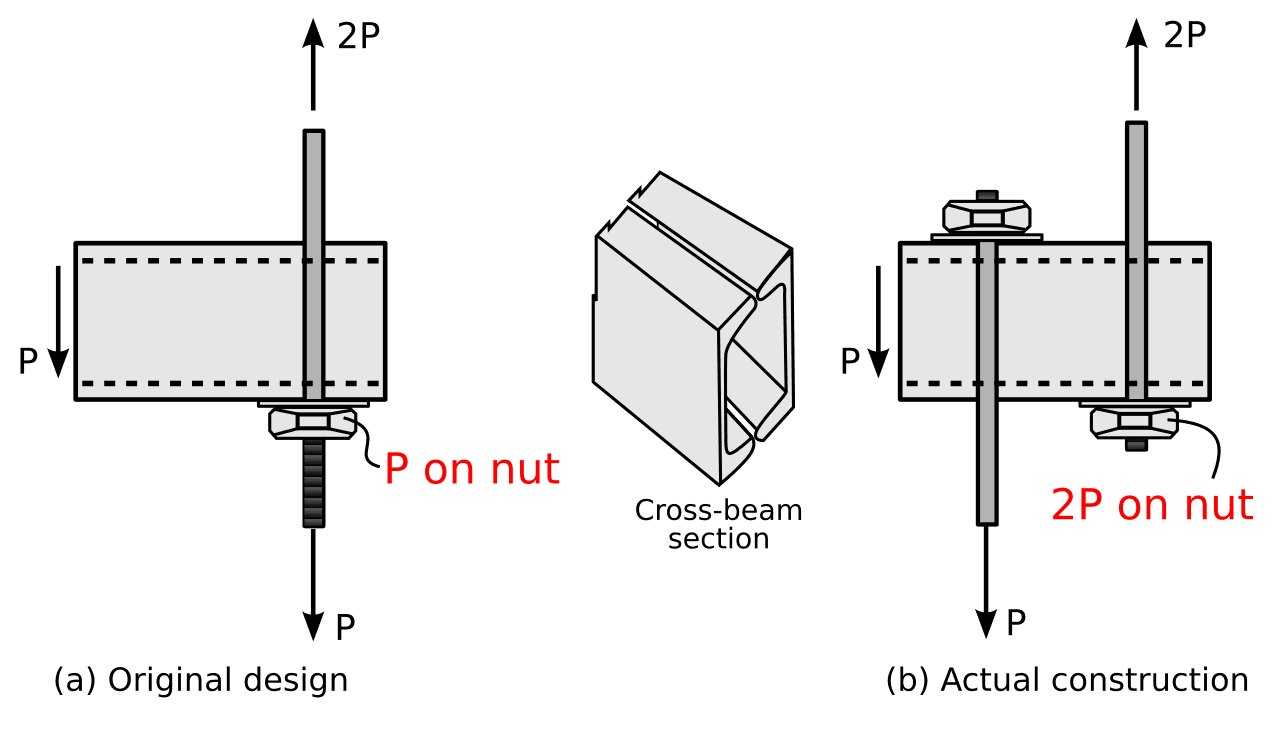
On the evening of 17 July 1981, a crowd had gathered for a tea dance in the atrium of the new Hyatt Regency hotel in Kansas City, USA. Some were standing on the suspended walkways above the floor. At about 7:05 p.m., the second- and fourth-floor walkways fell onto the crowded lobby. 114 people were killed and 216 injured[1].
The original design
The walkways hung from the atrium roof on steel hanger rods. In the original design, continuous rods ran from the ceiling, through the fourth-floor walkway beams and down to the second-floor walkway. Each walkway was held by its own nut on the same long rod[1].
The change
The steel fabricator found that design awkward to build — the long rods would have needed threading along much of their length. It proposed two separate sets of rods instead: one set hanging the fourth-floor walkway from the ceiling, and a second set hanging the second-floor walkway from the fourth-floor walkway[1],[3].
It looks like a minor detail. It is not. The fourth-floor beam connection now had to carry the second-floor walkway as well as its own — the force on that connection doubled[1],[2].
How it slipped through
According to the investigation, the change was accepted by the engineering team without the calculations being redone[1],[2]. The point that failed was a small one — where the fourth-floor box beam rested on a nut and washer on the hanger rod[1],[3]. Investigators from the US National Bureau of Standards found the walkways had only minimal capacity to resist their own weight, even before the crowd stepped onto them[1].
The consequences
The engineers of record were found guilty of gross negligence, misconduct and unprofessional conduct by the Missouri licensing board and lost their licences; the firm also lost its licences in several states[1]. The American Society of Civil Engineers later made it clear that structural engineers are responsible for reviewing fabricators’ shop drawings[1]. The case is now taught in engineering ethics courses around the world[2],[4].
The lesson for every engineer, on every site
Site changes happen every day: bars are substituted, laps are moved to a convenient place, a beam is dropped to clear a pipe, a column is shifted to save a parking slot, a staircase is hung from a beam instead of resting on a wall. Most are harmless. Some quietly change how the load travels — and only a calculation can tell which.
- Every structural change on site — however small — should go back to the structural engineer before it is built
- Shop drawings and fabrication details for steel work must be checked by the designer, not just filed
- Connections deserve as much attention as members — most collapses start at a joint
- Ask “what does this change do to the load path?” before asking “is it easier to build?”
That habit — checking the load path, not just the drawing — is exactly what we drill into engineers in the Civil Engineering Launchpad.
Sources
- [1]Wikipedia — Hyatt Regency walkway collapse
- [2]Online Ethics Center — Hyatt Regency walkway collapse
- [3]Design News — Engineering disasters: a deadly mistake in Kansas City
- [4]Knott Laboratory — Hyatt Regency walkway collapse
Indian Standards are published by the Bureau of Indian Standards; links point to public copies. Always design to the current edition.
This article is general information, not engineering advice for your building. Always have a qualified structural engineer check your structure. Read our disclaimer.
Learn this hands-on, or let us do it for you.