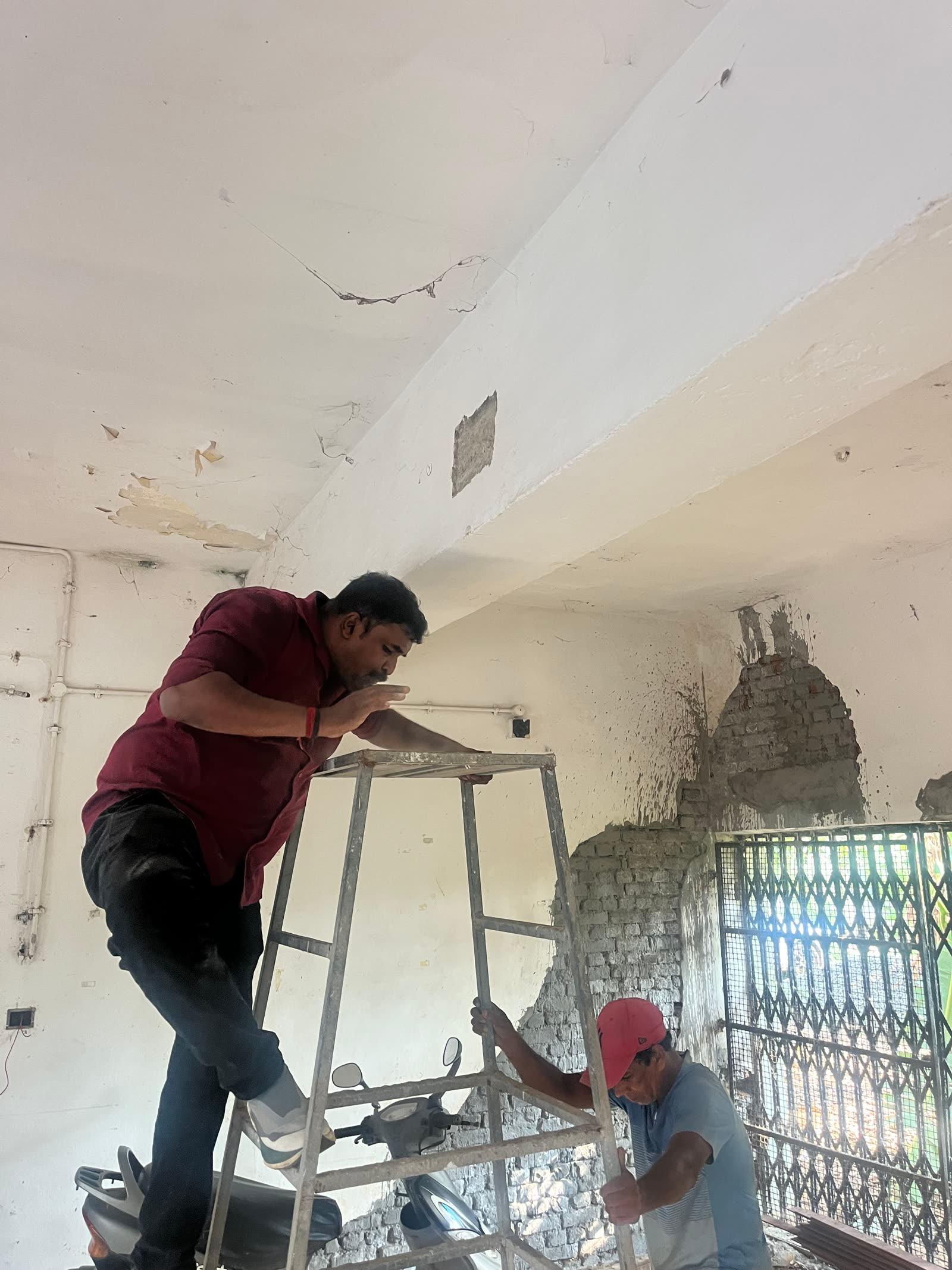
Many hospitals, schools and offices were built decades ago. Heavy rain, humidity, sea air and age take a toll on reinforced concrete. Our evaluations of public hospital buildings follow the approach below.
Warning signs
- Cracks in beams, columns or slabs, especially diagonal or widening cracks
- Spalling concrete and exposed, rusted reinforcement
- Rust stains and persistent dampness
- Sagging slabs or visible deflection
- Plans to add floors or change how the building is used
What a structural audit includes
An audit starts with a visual condition survey that maps every visible defect. Then tests measure the quality of the concrete — mostly non-destructive tests (NDT), backed by a few core samples where strength must be confirmed:
- Rebound hammer — surface hardness, used to estimate compressive strength[1]
- Ultrasonic pulse velocity (UPV) — uniformity of concrete and hidden voids or cracks[2]
- Core cutting (partially destructive) — small cylinders drilled out and tested in the lab for direct compressive strength; the holes are filled afterwards
- Half-cell potential — the likelihood of reinforcement corrosion
- Carbonation depth — how far the protective alkalinity of concrete has been lost
- Cover meter — the depth and position of reinforcement
The results feed into an analytical model of the existing building to check whether its members can still carry today’s loads. IS 15988 gives guidance on the seismic evaluation and strengthening of existing RC buildings[3].
Repair or strengthen?
Depending on the findings, the recommendation may be surface repair, strengthening or, rarely, demolition. Common retrofitting solutions include:
- Column and beam jacketing to increase strength and stiffness
- Polymer-modified mortar and micro-concrete repairs for spalled areas
- Corrosion treatment of exposed reinforcement
A structural audit costs a fraction of a new building — and tells you exactly how much life is left in the one you have.
Sources
- [1]IS 13311 (Part 2):1992 — NDT of Concrete: Rebound Hammer (BIS)
- [2]IS 13311 (Part 1):1992 — NDT of Concrete: Ultrasonic Pulse Velocity (BIS)
- [3]IS 15988:2013 — Seismic Evaluation and Strengthening of Existing RC Buildings (BIS)
- [4]IS 456:2000 — Plain and Reinforced Concrete, Code of Practice (Bureau of Indian Standards)
Indian Standards are published by the Bureau of Indian Standards; links point to public copies. Always design to the current edition.
This article is general information, not engineering advice for your building. Always have a qualified structural engineer check your structure. Read our disclaimer.
Learn this hands-on, or let us do it for you.