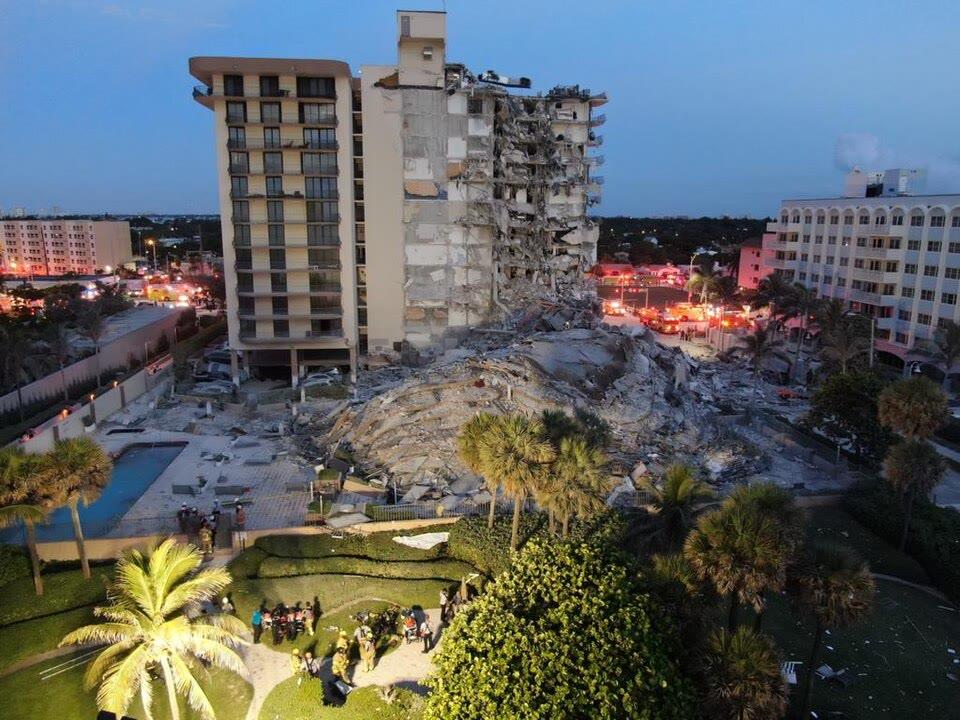
At about 1:22 a.m. on 24 June 2021, most of Champlain Towers South — a 12-storey, 136-unit beachfront condominium in Surfside, Florida — collapsed while its residents slept. 98 people died[1]. The building was 40 years old and was going through its 40-year safety recertification at the time[1].
The warning in 2018
Three years earlier, in October 2018, a consulting engineer inspected the building and reported a “major error” in the pool deck: its waterproofing had been laid flat instead of sloped, so rainwater sat on it until it evaporated[1]. The report warned that if the waterproofing was not replaced soon, “the extent of the concrete deterioration” would “expand exponentially”[1]. It also described large cracks and spalling in the parking garage below, with reinforcement exposed[1].
Repairs costing about $15 million were eventually approved. In April 2021, a letter to residents said the deterioration had become “much worse” since 2018. The main concrete repairs had still not started when the building fell[1].
What investigators found
The U.S. National Institute of Standards and Technology (NIST) led the federal investigation. In its technical findings, NIST concluded that a punching shear failure at two columns under the pool deck slab — where the slab tore around the columns — began in early June 2021, roughly three weeks before the collapse[2],[3].
- Primary causes: deficiencies in the original design and construction — and the building as built differed from its design[2],[4]
- Contributing factors: extra weight added to the pool deck over the years, and deterioration of the concrete and reinforcement[2]
- Warning signs of the coming failure were not acted on[4]
NIST’s full final report, with all the test results and computer modelling, is still being written[2].
What changed afterwards
In 2022, Florida passed a law requiring milestone structural inspections of condominium buildings over three storeys — first at 30 years of age (with an option of 25 years near the coast), then every 10 years — and stopped associations from waiving reserve funds for structural repairs[1].
The lesson for every engineer
Surfside was not a freak event. Its ingredients are found in ageing concrete buildings everywhere — especially near the sea:
- Water getting into concrete through failed terrace, podium or pool waterproofing
- Salt-laden coastal air that speeds up corrosion of the steel inside the concrete
- Spalling and rust stains in basement parking that are painted over instead of investigated
- Heavy additions — terrace gardens, water tanks, tiles over old tiles — that the structure was never designed for
- Repairs delayed because the association cannot agree on who pays
Good concrete with the right cover for the exposure — as every concrete code requires, IS 456 included — is the first defence[5]. The second is regular inspection. A structural audit with non-destructive testing costs a tiny fraction of a building — and it turns a warning into a plan.
Sources
- [1]Wikipedia — Surfside condominium collapse
- [2]NIST — Technical findings on what caused the 2021 partial collapse of Champlain Towers South
- [3]WLRN — Investigators point to pool deck as origin of Champlain Towers South collapse
- [4]Washington Examiner — Federal investigators reveal cause of 2021 Surfside condo collapse
- [5]IS 456:2000 — Plain and Reinforced Concrete, Code of Practice (Bureau of Indian Standards)
Indian Standards are published by the Bureau of Indian Standards; links point to public copies. Always design to the current edition.
This article is general information, not engineering advice for your building. Always have a qualified structural engineer check your structure. Read our disclaimer.
Learn this hands-on, or let us do it for you.